
"Driving Quantum Innovations: Volkswagen and Mercedes-Benz Shaping Tomorrow's Mobility"

Introduction
In the realm of cutting-edge technology, Quantum Computing stands as a beacon of limitless possibilities. Rooted in the realm of quantum mechanics, this paradigm-shifting technology is poised to transform industries, disrupt conventional computing norms, and unlock unprecedented computational power. This blog journey delves into the origin of Quantum Computing, its evolution, key providers and their offerings, current applications with real-world case studies, and a glimpse into its future trajectory.

Source: Google Quantum AI Campus
Origins and Evolution
Quantum Computing traces its roots to Richard Feynman's visionary idea in 1981 of using quantum systems to simulate physical phenomena. The concept of harnessing quantum bits or "qubits," which can represent both 0 and 1 simultaneously due to quantum superposition, forms the basis of quantum computing's power. From theoretical foundations to practical realizations, quantum computing has come a long way.
Quantum computing VS Traditional computing :

Key Quantum Computing Providers and Offerings
IBM Quantum: IBM's Q System One is a notable quantum computer, accessible through the cloud. It features qubits designed for stability and offers the IBM Quantum Experience, a platform to experiment with quantum algorithms.

Source: Quantum computing. IBM.com
Google Quantum Computing: Google's quantum supremacy experiment with its Sycamore processor marked a milestone. Its quantum hardware is built for specific tasks, and Google aims to develop quantum error correction.

Source: Google Quantum computing hardware
Rigetti: Rigetti offers cloud-based quantum computing services. Its Quantum Cloud Services (QCS) provides access to quantum hardware, Quantum Virtual Machines (QVMs), and Forest, a quantum programming environment.

Source: Rigetti.com
D-Wave Systems: D-Wave's quantum annealing technology is suited for optimization problems. Their systems are designed to solve complex problems by exploiting quantum tunneling.

Source: Dwavesys.com
"Driving Innovation: Mercedes-Benz, IBM, and Google Collaborate on Quantum Computing for Automotive Industry"
Mercedes Benz, IBM, and Google created a tri-party partnership to do research on Quantum Computing for Automotive industry applications. Mercedes-Benz incorporated quantum computing into its battery design simulation process. Quantum computers allowed for accurate modeling of quantum phenomena in battery materials, enabling precise predictions of properties like energy storage capacity, charging rate, and cycle life. This information facilitated the development of novel materials with improved performance, leading to the creation of high-performance and sustainable batteries for their electric vehicles.
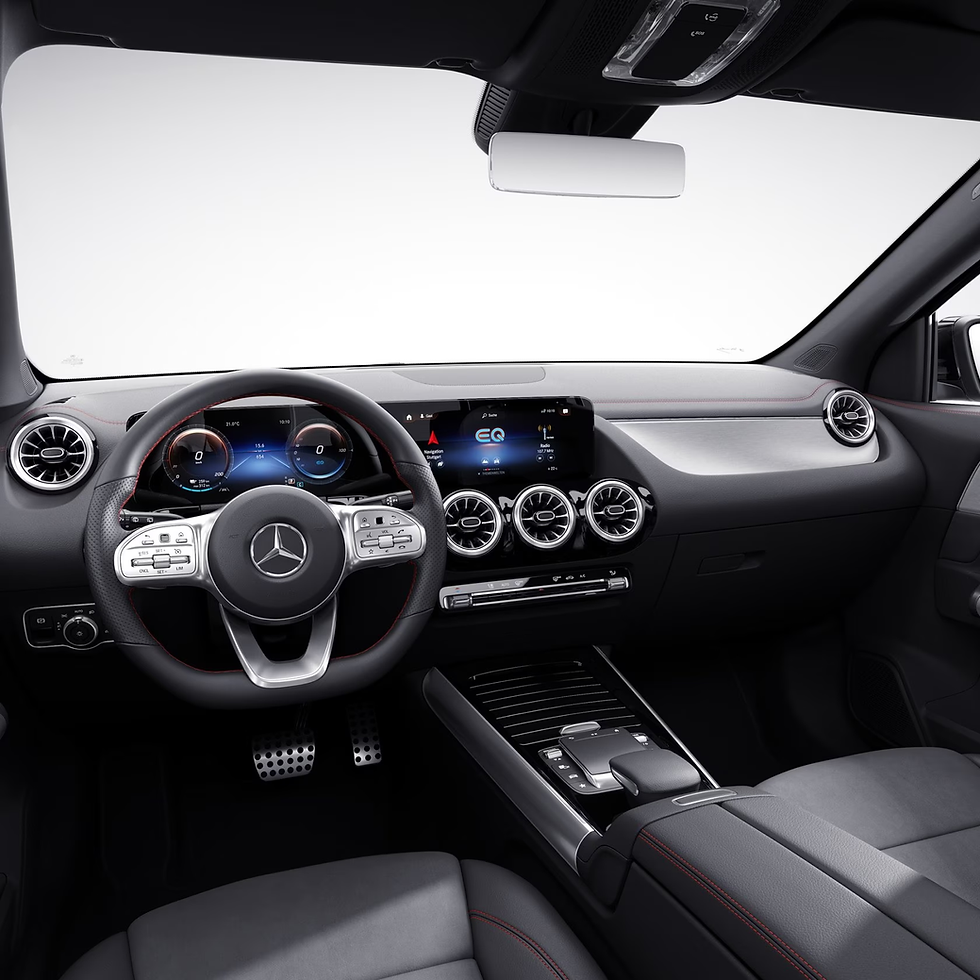
Source: Mercedes Benz EQ - Electric car
In addition to the use of quantum computing for battery design, Mercedes-Benz is also exploring other potential applications for the technology, such as:
Optimizing the performance of combustion engines: Quantum computers could be used to simulate the combustion process in engines, leading to improvements in fuel efficiency and em§issions.
Developing new safety features for vehicles: Quantum computers could be used to simulate the behavior of vehicles in different crash scenarios, leading to the development of safer cars.
Creating personalized driving experiences: Quantum computers could be used to collect and analyze data about a driver's preferences and habits, and then use this data to create a personalized driving experience.
"Volkswagen's Quantum-Powered Traffic Optimization Success: Efficient Routes for City Transportation"
Volkswagen's software engineers aimed to address this issue using a D-Wave 2000Q™ quantum computer. They gathered movement data from 418 taxis in Beijing, one of the world's busiest cities, to optimize traffic flow between the city center and the airport. The successful proof of concept led to the creation of a mobile app that predicts the best routes for various destinations. This app was introduced at the 2019 WebSummit in Lisbon. Volkswagen also employed this approach for optimizing bus routes during the event, utilizing traffic data from Here Maps to guide bus drivers and reduce waiting times for passengers.

Source: Dwavesys.com
Diverse Applications Explored by Leading Organizations :
Optimization: Quantum computing excels at solving optimization problems like Volkswagen and D-Wave collaborating again to optimize the car painting process.
Drug Discovery: Quantum computers can simulate molecular interactions at an atomic level, speeding up drug discovery. Honeywell collaborated with Cambridge Quantum Computing to explore quantum-enhanced chemistry simulations.
Cryptography and Security: Quantum computing threatens conventional encryption. ISARA Corp is working on quantum-safe cryptography to ensure data security in the quantum era.
Material Science: Microsoft collaborated with Pacific Northwest National Laboratory to simulate the behavior of topological materials using a quantum computer, accelerating advancements in electronics.
Future Outlook :
The future of Quantum Computing holds immense promise:
Quantum Advantage: As technology matures, quantum computers will tackle problems beyond classical capabilities, revolutionizing fields like cryptography, optimization, and material science.
Quantum Machine Learning: Quantum computers can enhance machine learning models by processing complex data more efficiently, paving the way for new AI breakthroughs.
Quantum Internet: The creation of a quantum internet will enable ultra-secure communication and distributed quantum computing, transforming global connectivity.
Quantum Simulations: Quantum computers will simulate quantum systems, revolutionizing fields such as material science, drug discovery, and fundamental physics research.
Conclusion :
The potential applications of quantum computing for industries are vast, and companies like Mercedes-Benz are exploring these possibilities together with the providers. As quantum computing technology continues to develop, it is likely that we will see even more innovative and groundbreaking applications for this technology in every industry.


Comments